A. Animal
and human language
1. Displacement:
property of human language.
2. Arbitrariness:
aspect of relationship between linguistics sign and objects in the world.
3. Productivity:
expression that manipulating the linguistics
4. Cultural
transmission: process that a language is passed on from one generation.
5. Duality:
organize of human language at two level or layers simultaneously.
B. Phonetics
1. Phonetics:
general study of the characteristics of speech sounds.
2. Place
of articulation

|
No.
|
Kind
|
Explanation
|
Symbols
|
Example
|
|
1
|
Bilabial
|
The lips are brought together
|
p, b, m, w
|
Pay, bay, may
|
|
2
|
Labiodental
|
The lower lip is raised toward the upper front
teeth
|
f, v
|
Safe, save
|
|
3
|
Dental
|
Touching the upper front teeth with the tip of
the tongue
|
Θ,
δ
|
Clothe, the, this, than
|
|
4
|
Alveolar
|
Raising the tip of the tongue towards the
alveolar ridge
|
t, d, s, z, n, l
|
Do, zoo, look
|
|
5
|
Palatoalveolar
|
Raising the blade of the tongue toward the part
of palate
|
ʃ, ʒ,
ʤ, ʧ, r
|
Pressure, batch
|
|
6
|
Palatal
|
Produced with the tongue and the palate
|
j
|
Yes, yellow
|
|
7
|
Velar
|
Raising the back of the tongue toward the soft
palate
|
k, ŋ,
g
|
Bag, bang
|
|
8
|
Glottar
|
Produced without the active place of articulation
|
h
|
high
|
3. Manner
of articulation
a. Stop:
sounds in which there is a complete closure in the mouth, so that the air
is blocked for a fraction of a second and then released with a small burst of
sound
b. Fricatives:
have a closure which is not quite complete.
c. Affricatives:
are a combination of a stop and a fricative
d. Nasals:
like stop, except that there is a completeclosure in the mouth
e. Liquids:
are sounds where the air escapes around the sides of the tongue
f.
Glides: are sounds where the tongue only
approaches the roof of the mouth, so that there is not enough obstruction to
create any friction
4. Vowels:
while the consonant sound are mostly articulated via obstruction in the vocal
track.
5. Diphthongs:
combination of two vowel sound.
6. Voiceless:
the vocal cord are spread apart.
7. Voiced:
the vocal cord are drawn together.
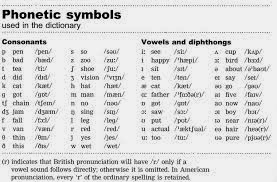
C. Phonology
1. Phonology:
sistem of speech sound.
2. Phonemes:
the smallest distinguishing sound in the language. Seen between / /, are the
individual sounds and are abstract mental units. They are not physical sounds.
3. Phones: a phonetic segment represented
by [ ]. Phones are phonetic symbols or the realization of phonemes. One phoneme
may be realized as more than one phone/phonetic segment.
4. Allophones:
one of a set of multiple possible spoken sounds used to pronounce a single phoneme.
5. Syllables:
is a unit of organization for a sequence of speech sounds.
For example, the word water is composed of two syllables: wa and ter.
6. Minimal
pairs: two word that different but
have similar sound. Ex: [bit] ("beat") /i/, [bɪt] ("bit") /ɪ/, [bet]
("bait") /e/
7. Minimal
set: whe a group that different and
changing
8. Assimilation:
is a common phonological
process by which one sound becomes more like a nearby sound.
D. Morphology
1. Morphology:
is a part of linguistic which identify language as grammatical units.
2. Morpheme:
smallest unit that carries information about meaning or function. Such us: (-er)
is like writer, runner, reader or (re-/) is like reconsider, relive,
recharge. (imbuhan)
a. Morpheme
level of analysis:
1) Simple/monomorphemic
words : no further subdivision
2) Complex/polymorphemic
words : 2 or more morphemes
a) Free
morphemes (a morpheme can stand by themselves as single word). Ex: open and
tour.
b) Bound
morphemes ( a morpheme cann’t stand alone must be attached to another
element; -s, -er, -ed as affixes in word form). Ex: undressed, carelessness
b. Branch
of free in morpheme
1) Lexical
morphemes: is the word categories which are treated as an ‘open’ class of
word in setting of ordinary nouns, adjectives, and verbs.
Ex: house, tiger, sad, long, yellow, open, etc.
2) Functional
morphemes: is the word categories which are treated as a ‘closed’ class of
word in setting of conjunctions, prepositions, articles, and pronouns.
Ex: and, but, when, because, on, near, etc.
c. Branch
of bound in morpheme
1) Derivational
morpheme: use prefixes (re-, pre-, mis-, co-, etc.) and suffixes (-full,
-ness, -less, -ly, etc.) that is combined in a word, change the meaning of word and make new word different
grammatical category from the stem.
Ex: (careful, careless, review, reset, etc)
2) Inflectional
morpheme: is not use to produce new words, but to indicated the grammatical
function. (noun, past-form, possesive, comparative)
Ex: Jim’s two sisters are really
different. (noun)
3. Allowmorph:
variation of realization of morpheme
|